A diary can contain many observations from one person, a few from another and different sequences across time. Reducing those records to a single percentage is useful, but it requires a counting rule. Before asking whether an average is impressive, ask what was averaged and what the averaging process leaves behind.
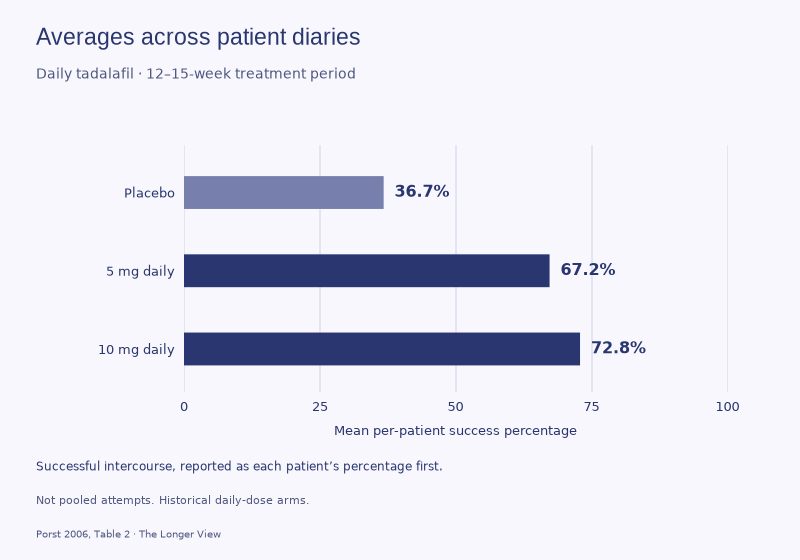
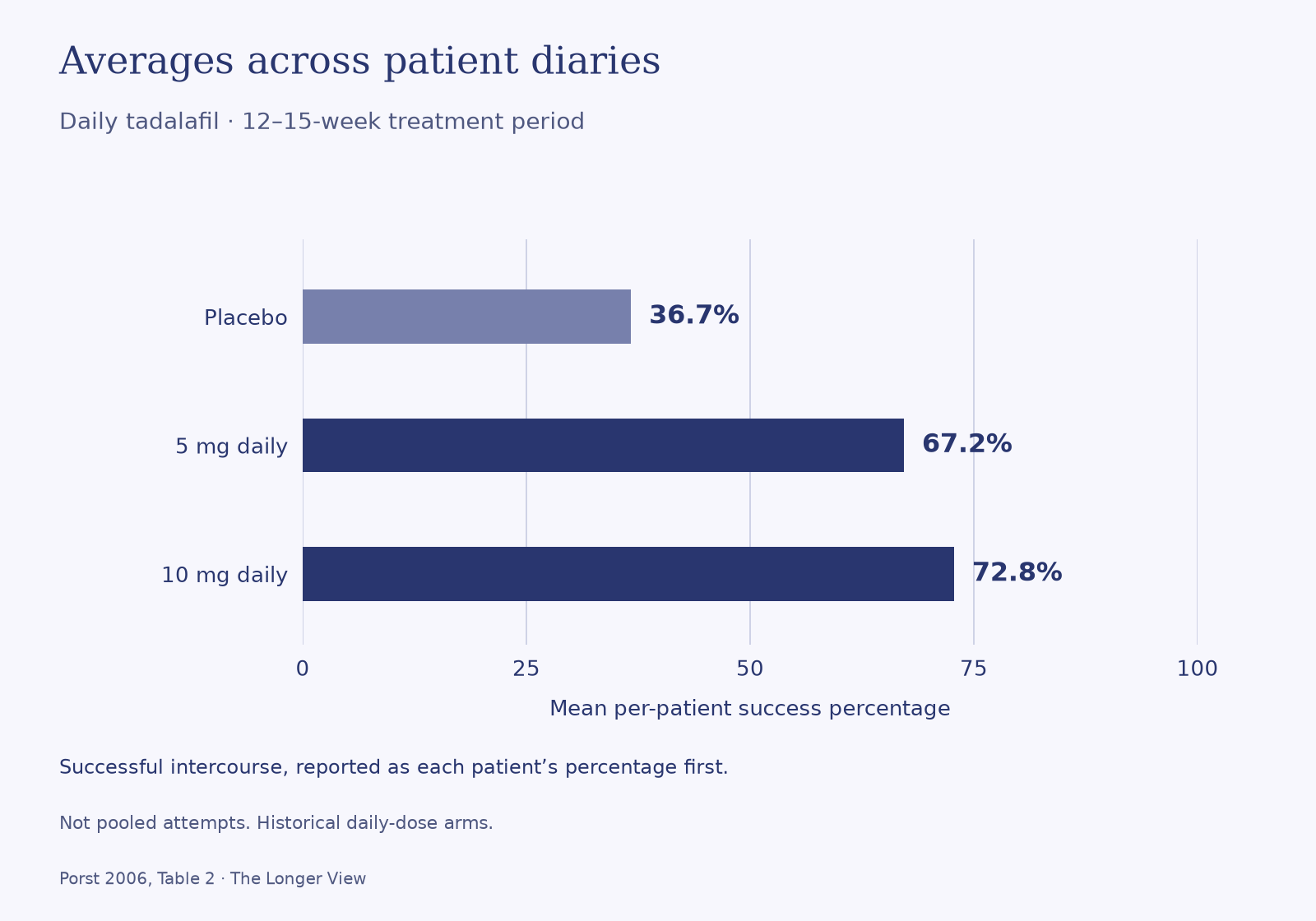
This analysis uses daily tadalafil research to examine that problem. The chart presents the published group results. The worked examples below use invented numbers to explain aggregation, change and timing; they are not reconstructions of participants’ diaries. The central task is to follow the unit of measurement from an individual record to a group summary, then identify which conclusions still require information that the summary cannot supply.
Read the reported result
| Group | Mean per-patient % |
|---|---|
| Placebo | 36.7% |
| 5 mg daily | 67.2% |
| 10 mg daily | 72.8% |
Treatment-period patient averages; see the explanation below.
Historical study arms, not prescribing instructions.
1Follow the record from an encounter to a person
The Sexual Encounter Profile question discussed here, SEP3, asks whether an erection lasted for successful intercourse. Once that question is answered repeatedly, several summaries become possible. One can calculate a percentage within each person’s diary, combine those percentages, or pool all recorded encounters into one total. These operations need not give the same result.
A useful way to read an analysis is to draw three boxes on paper: encounter, person and treatment group. Place the original observation in the first box, the individual summary in the second and the group result in the third. Then label each arrow with the operation used to move between boxes. This makes an otherwise abstract word such as average much more concrete.
The exercise also separates recording from dosing. A daily treatment schedule does not tell us how many diary entries someone produced, and a diary entry is not a dose count. Our guide to daily and as-needed arrangements explains the scheduling distinction. Here, the question is how observations become evidence, rather than which schedule a particular person should follow.
12Two correct averages can answer different questions
Consider a hypothetical pair of diaries. Person A records one successful encounter out of two, giving fifty percent. Person B records eight out of eight, giving one hundred percent. The simple average of the two personal percentages is seventy-five percent. If all encounters are pooled instead, there are nine successes among ten encounters, giving ninety percent.
Neither result is an arithmetic error. The calculations answer different questions. In the first, each person contributes one percentage to the average. In the second, each recorded encounter contributes to the combined fraction. The person with more encounters therefore contributes more entries to the pooled calculation. The difference comes from the chosen unit, not from a disagreement about which encounters were successful.
These invented diaries illustrate a mathematical distinction; they do not reproduce the trial’s individual data or its statistical adjustment. A reader should resist switching between summaries merely because both carry a percent sign. To interpret a reported value, preserve the original aggregation rule and explain what receives equal representation under that rule. That information is part of the result’s meaning.
| Record or summary | Calculation | Result |
|---|---|---|
| Person A | 1 success / 2 encounters | 50% |
| Person B | 8 successes / 8 encounters | 100% |
| Simple average of people | (50% + 100%) / 2 | 75% |
| Pooled encounters | 9 successes / 10 encounters | 90% |
The counting rule determines whose observations dominate
The hypothetical example can be extended without changing either person’s percentage. Imagine duplicating Person B’s complete pattern of eight successes while leaving Person A’s diary unchanged. The simple average of the two percentages remains the same. The pooled fraction changes because one person now supplies more recorded encounters. This is a consequence of the arithmetic, not a claim about how real participants behaved.
That distinction helps a reader identify the scientific question behind a summary. A person-based average asks about the collection of individual percentages. An encounter-based proportion asks about the collection of recorded encounters. Neither description is automatically the best choice for every purpose. The choice should fit the question, and it should remain visible when results are presented to readers.
An average also cannot describe how much variation existed among individuals without additional information. Many different sets of personal percentages can produce the same group average. A middle value might summarize similar experiences or very different ones. To distinguish those possibilities, the reader needs information about the distribution, not a more elaborate interpretation of the single average.
1Matching totals can conceal opposite sequences
Now imagine two people who each record eight encounters, with four marked successful. One has all four successes in the earlier half of the diary; the other has them in the later half. Their overall percentages are identical. Their sequences are not. This invented example shows exactly what disappears when the order of observations is removed.
A question about onset requires knowing when a change began. A question about consistency requires knowing how experiences varied from one occasion to another. An overall percentage cannot answer either question by itself, even when the denominator is perfectly clear. Preserving a sequence, or reporting suitable time-specific summaries, would provide different information from the aggregate.
For a personal follow-up conversation, the useful lesson is to describe patterns as well as a broad impression. Our guide to talking about your response offers a place to begin. This is an editorial interpretation of measurement: two summaries may agree while the underlying experiences differ. It is not a claim that either of the imagined patterns occurred in the published trial.
| Invented diary | Order of eight records | Overall result |
|---|---|---|
| Earlier successes | Four successes, then four unsuccessful encounters | 4 / 8 = 50% |
| Later successes | Four unsuccessful encounters, then four successes | 4 / 8 = 50% |
| What the total omits | Order and spacing of observations | The percentage alone cannot restore them |
An observation period is different from an effect window
The length of a study tells a reader when research observations were collected. It does not automatically identify how long an individual dose had an effect, how quickly benefit began or what happened after treatment ended. Each question has its own starting event, ending event and required observations. Using the word duration without naming those events can blur distinct claims.
A calendar can make the distinction visible. Mark the period during which treatment is assigned, the dates on which outcomes are recorded and any period after treatment has stopped. A conclusion about one part of that calendar requires observations from that part. A long span of enrollment cannot substitute for a measurement made at a particular time relative to a dose.
The guide to understanding the 36-hour window addresses a familiar example of timing language. The broader reading habit is to ask which clock a sentence uses. Repeated dosing, repeated measurements and continued benefit after stopping are separate propositions. A group average collected over weeks should not be converted into an individual timetable simply because both descriptions involve time.
12A percentage at follow-up is not its change from baseline
Suppose an invented diary summary starts at forty percent and later reaches sixty-five percent. The later value is sixty-five percent. The absolute change is twenty-five percentage points. The relative increase is twenty-five divided by forty, or sixty-two and a half percent. All three statements use the same two starting numbers, but they describe different quantities.
The wording around a number is therefore essential. A report of a percentage-point change cannot be substituted for the final percentage. A relative change cannot be interpreted as the share of people helped. Nor can a final value reveal the starting value without another piece of information. These are algebraic limits, not questions that a confident tone can resolve.
A helpful reading exercise is to write the equation beside the statement. For an absolute change, subtract the starting percentage from the later percentage. For a relative change, divide that difference by the starting value. If the starting value is zero, that relative calculation is undefined. Naming the operation makes it much harder to confuse a large-looking change with the outcome level itself.
1A comparison needs the same scientific question on both sides
A placebo comparison and a comparison between two schedules are different research questions. So are a comparison of diary summaries and a comparison of overall judgments of improvement. Before placing results alongside each other, identify the outcome, the population, the observation period and the treatment arrangement on each side. Similar vocabulary does not establish that these elements match.
Our sildenafil analysis of response counts examines how a yes-or-no improvement question should be read. That discussion can help clarify the measurement contrast without turning the two articles into a treatment ranking. A person’s overall judgment and a numerical diary summary may each be informative while preserving different details about an experience.
As a thought exercise, write the question you would want a new study to answer. If the decision concerns two schedules, specify those schedules. If it concerns reliability over time, specify the repeated measurements needed. This step exposes the distance between a desired conclusion and the evidence available. It also helps explain why a useful result may still leave an important practical question unresolved.
132More records do not automatically resolve uncertainty
The number of people assigned treatment, the number with usable outcome measurements and the number of recorded encounters answer different counting questions. A large value for one does not reveal either of the others. It also does not, by itself, provide the variability needed to calculate the uncertainty around a mean. The data structure matters as well as its size.
Return to an invented diary. If an encounter was not recorded, the missing entry does not tell us whether it was successful, unsuccessful or outside the recording rule. Any procedure that fills the gap must state what is being assumed. A precise definition of the denominator is necessary, but it does not turn an unobserved event into an observed one.
The same care applies to borrowing an analytical rule from another outcome. A method designed for a questionnaire score may not describe how a diary was analyzed. The reader should follow the method attached to the endpoint under discussion. When details are unavailable, the appropriate conclusion is that the reconstruction is incomplete. Adding simulated precision would hide that gap rather than close it.
1Separate research doses from present prescribing decisions
Dose labels identify research groups; they do not prescribe a regimen for a reader. Current Cialis labeling describes daily erectile-dysfunction dosing at 2.5 mg or 5 mg, so the historical 10 mg daily arm is not current routine daily ED labeling. The point of that comparison is to identify different contexts, not to suggest starting, increasing or substituting a dose.
The same label contraindicates nitrates and guanylate cyclase stimulators such as riociguat. An erection lasting more than four hours requires immediate medical care. Sudden vision loss calls for stopping the medicine and obtaining care; sudden hearing decrease or loss calls for stopping and prompt attention. These labeling warnings address safety decisions separately from the study’s diary averages.
For a consultation, bring the complete medicine list and describe any concerns in concrete terms. Our medicine-check guide helps organize that preparation. A benefit measure cannot settle a medicine-interaction question, and an overall discontinuation count cannot describe every type of harm. Each statement should remain attached to the outcome it actually measures and the evidence that supports it.
21Check the product claim separately from the service terms
An ingredient name can appear in descriptions of different formulations and care arrangements. To apply research to a particular product, first establish the product’s identity and the evidence relevant to that form. To assess a service, examine its documented terms and follow-up arrangements. Those tasks do not become the same task because they appear together on one website.
FDA states that compounded medicines are not FDA approved and do not undergo its premarket review of safety, effectiveness and quality. The distinction is relevant to evidence matching; it is not a claim that every compounded medicine is ineffective. The guide to Cialis, generics and compounds explains the categories a reader may encounter while checking a description.
The Ro tadalafil review can serve as a documentary starting point for terms that should be verified directly. Linking it here does not establish outcomes for that provider. Our editorial approach is to keep three questions separate: what the research measured, what product is being described and what the service promises. Each needs evidence appropriate to its own claim.
421Questions about the evidence
Why can a pooled percentage differ from a person-based average?
Pooling gives each recorded encounter a place in one combined fraction. A simple average of personal percentages gives each person one percentage to contribute. When people have different numbers of encounters, those operations need not agree. The invented two-diary example demonstrates that distinction without reconstructing the trial’s individual records.
1Does a group average tell me how consistent the response was?
Not on its own. Different sequences and different spreads of individual experiences can share the same average. Consistency requires information about variation across occasions or people, depending on the question. A single summary can be useful while leaving that pattern unresolved; extra decimal places do not supply the missing pattern.
1Can I treat the study’s follow-up as the duration of a dose?
No. Study follow-up and time relative to a dose use different reference points. To evaluate a duration claim, identify the event that starts the clock, the event that ends it and the observations between them. A treatment-period summary does not become a dose-level timing measurement through interpretation alone.
12What if the paper gives a mean but no interval?
Preserve the reported mean and state the limit of the available uncertainty information. Do not borrow an interval from another outcome or invent error bars from a sample size alone. A defensible calculation requires the relevant data structure, variability and analytical assumptions, rather than only the displayed average.
1What is the most useful question to bring to a discussion?
Ask which aspect of the experience matters for the decision: overall change, consistency, timing, tolerability or the practical care arrangement. Those questions call for different observations. A clear description helps a clinician discuss the evidence in context, without treating one published percentage as a complete account of an individual’s needs.
12A useful question to carry forward
A diary average is most informative when the path to it remains visible. Identify the original observation, the individual summary, the group calculation and the time period. Then ask which details were compressed: the number of encounters, their sequence, variation between people or unrecorded events. The published result can inform a discussion without answering all of those questions. Carrying forward a precise question about the missing detail is more useful than turning the average into a personal forecast or an unsupported comparison.
Evidence access
Relevant primary methods, results and disclosures were re-read from retained papers. No participant-level records, protocol or supplement review is claimed. Official labeling and FDA material were checked October 25, 2026. The arithmetic examples are hypothetical.
Where to read more
Scientific sources have their own checked dates below. Earlier source records retain their original checks. Provider pages describe their advertised services. Medical references do not endorse this publication or its sponsor.
- Porst 2006Study · Checked 2026-10-25
- Cialis prescribing informationOfficial prescribing information · Checked 2026-10-25
- Goldstein 1998Primary research · Checked 2026-10-25
- FDA: compounded drugsFDA guidance · Checked 2026-10-25